FREE U.S. SHIPPING ON ORDERS $45+

FREE U.S. SHIPPING ON ORDERS $45+
✓ Instant download — your file is ready at checkout
✓ Nothing ships — printable PDF, yours to keep
✓ Download it again anytime — no expiry


Money skills they can actually use, and lessons you can actually teach.
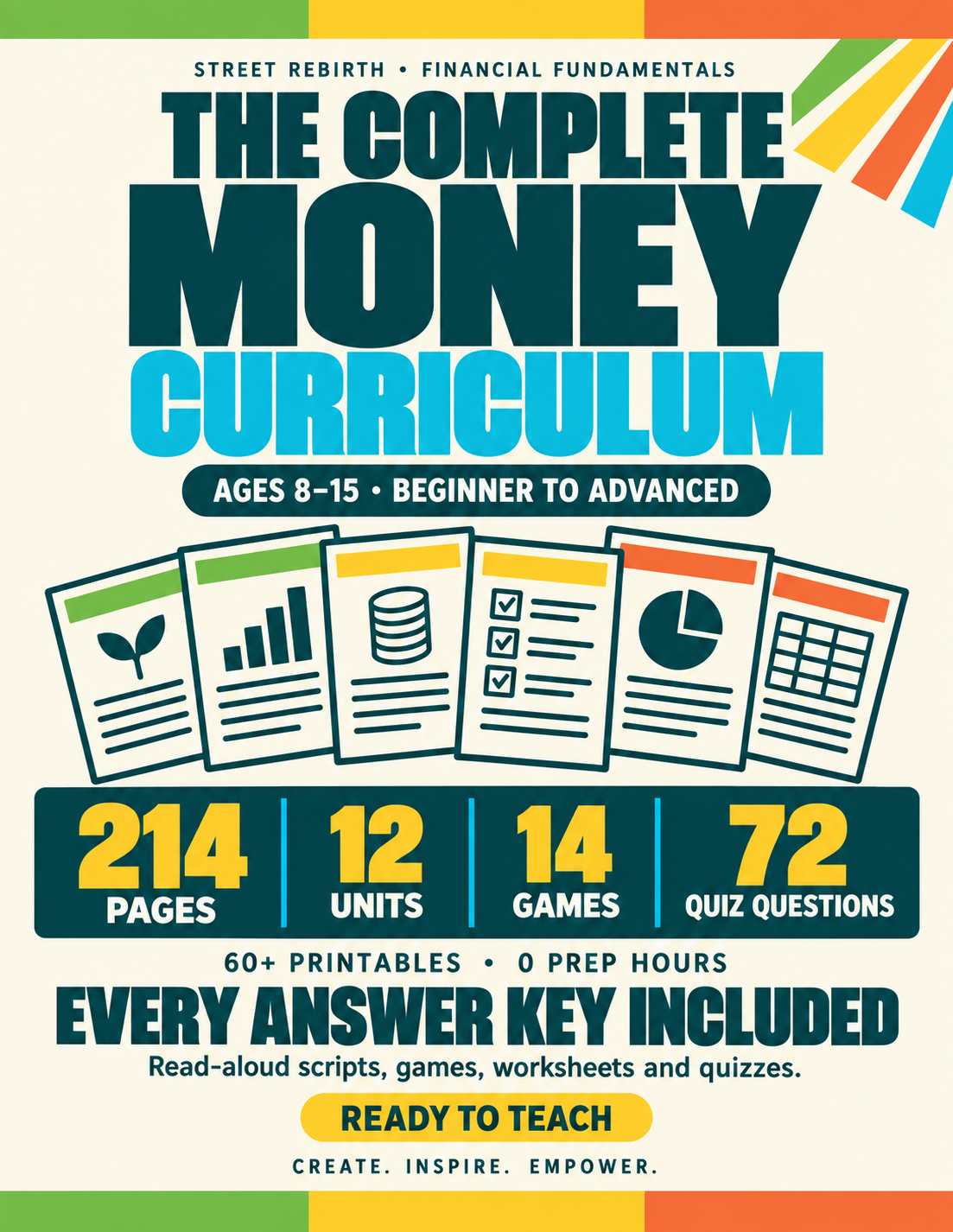
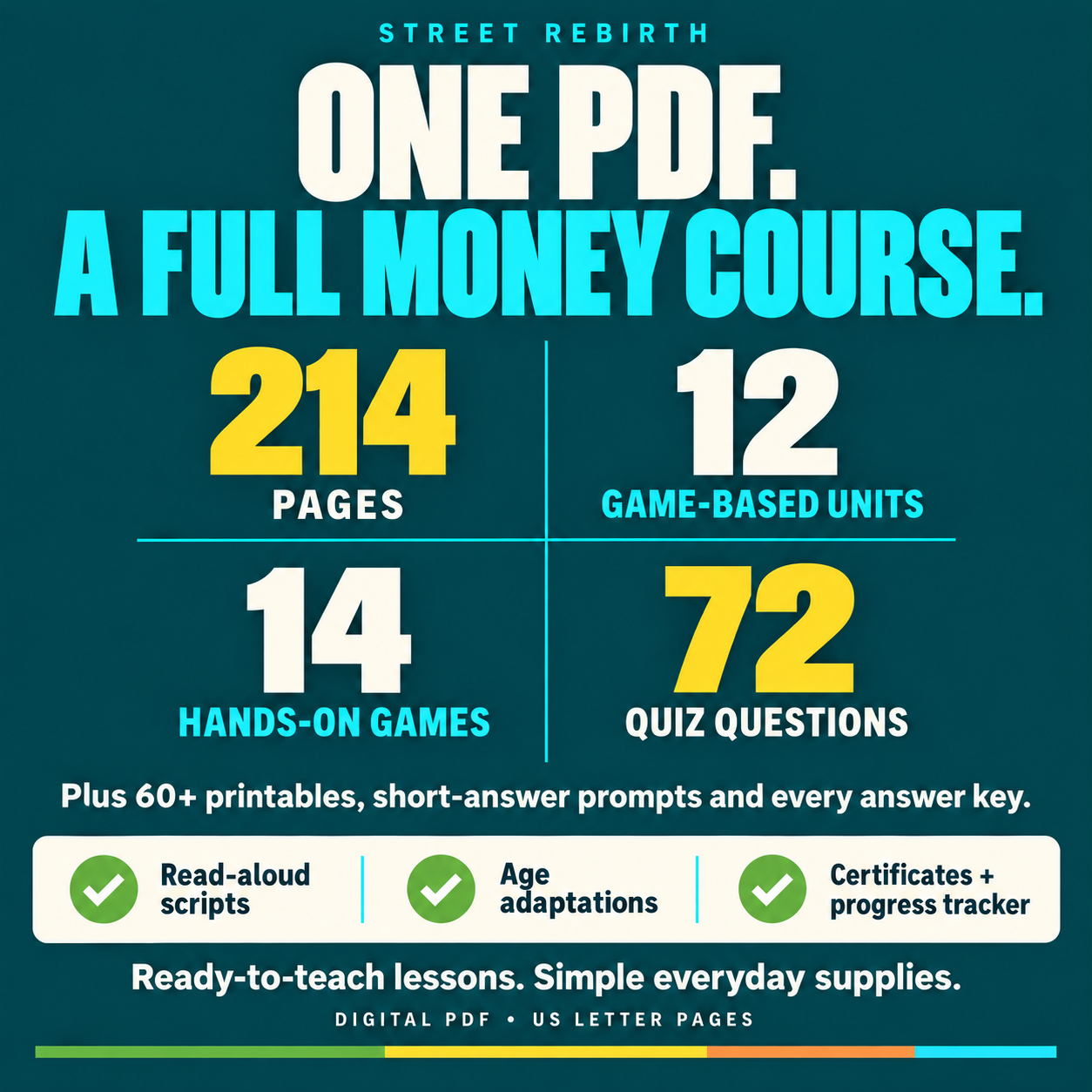
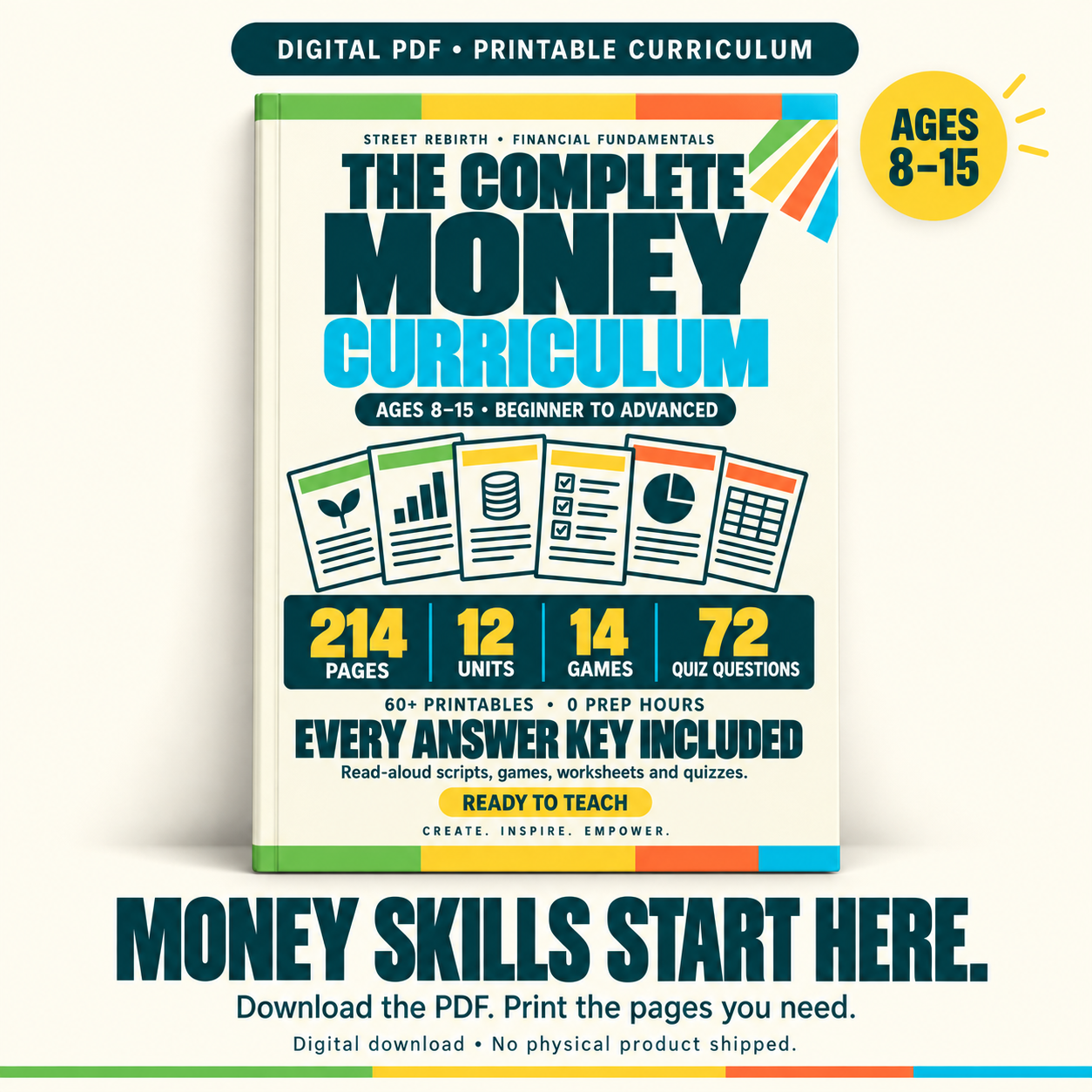
Financial Fundamentals: The Complete Money Curriculum is a 214-page printable PDF that turns money into something kids do, not something they memorize. Twelve ready-to-teach units cover everything from what money actually is to budgeting, saving, banking, credit and debt, compound interest, advertising, starting a business, investing, inflation, taxes and net worth. Every unit is built the same way, so once you have taught one, you can teach all twelve.
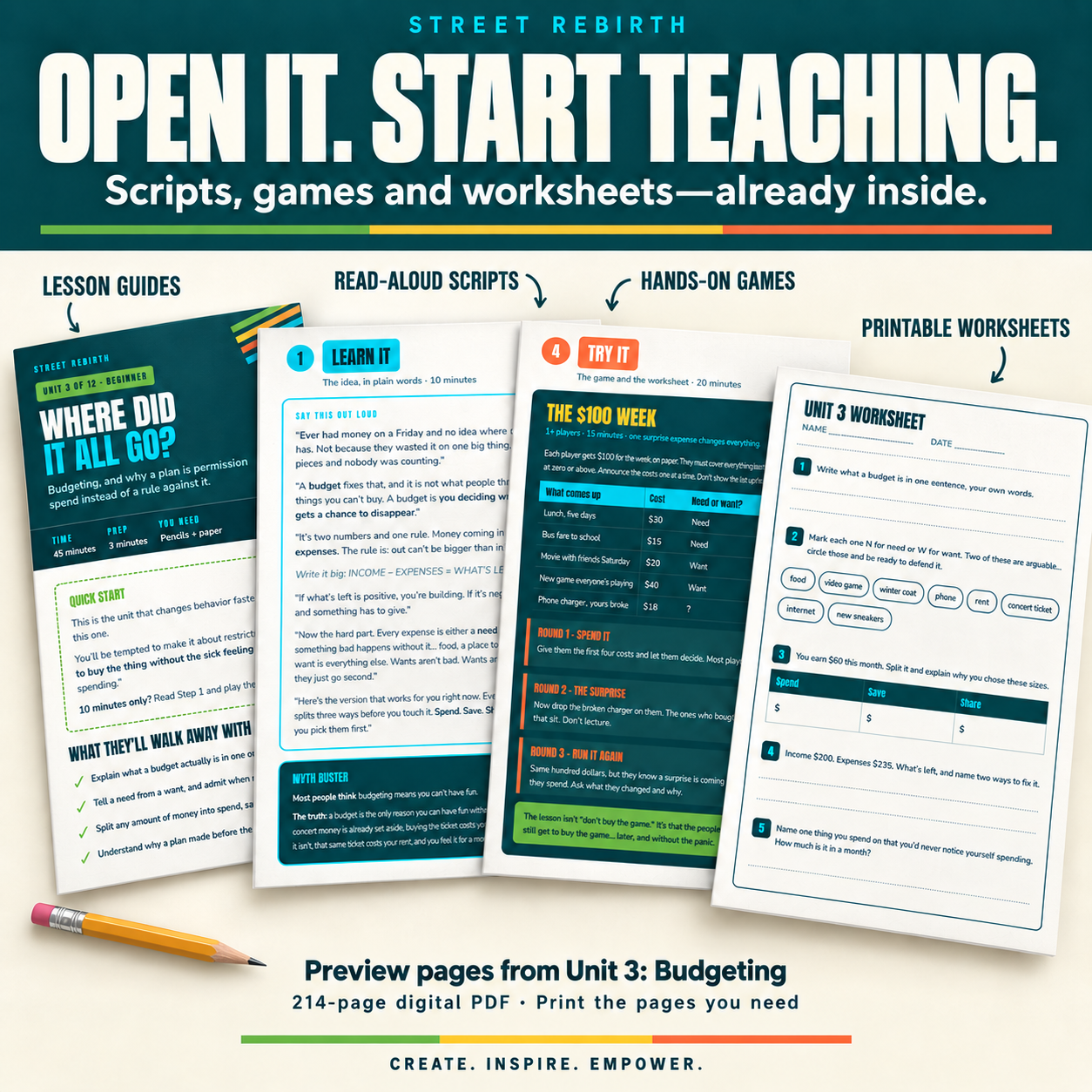
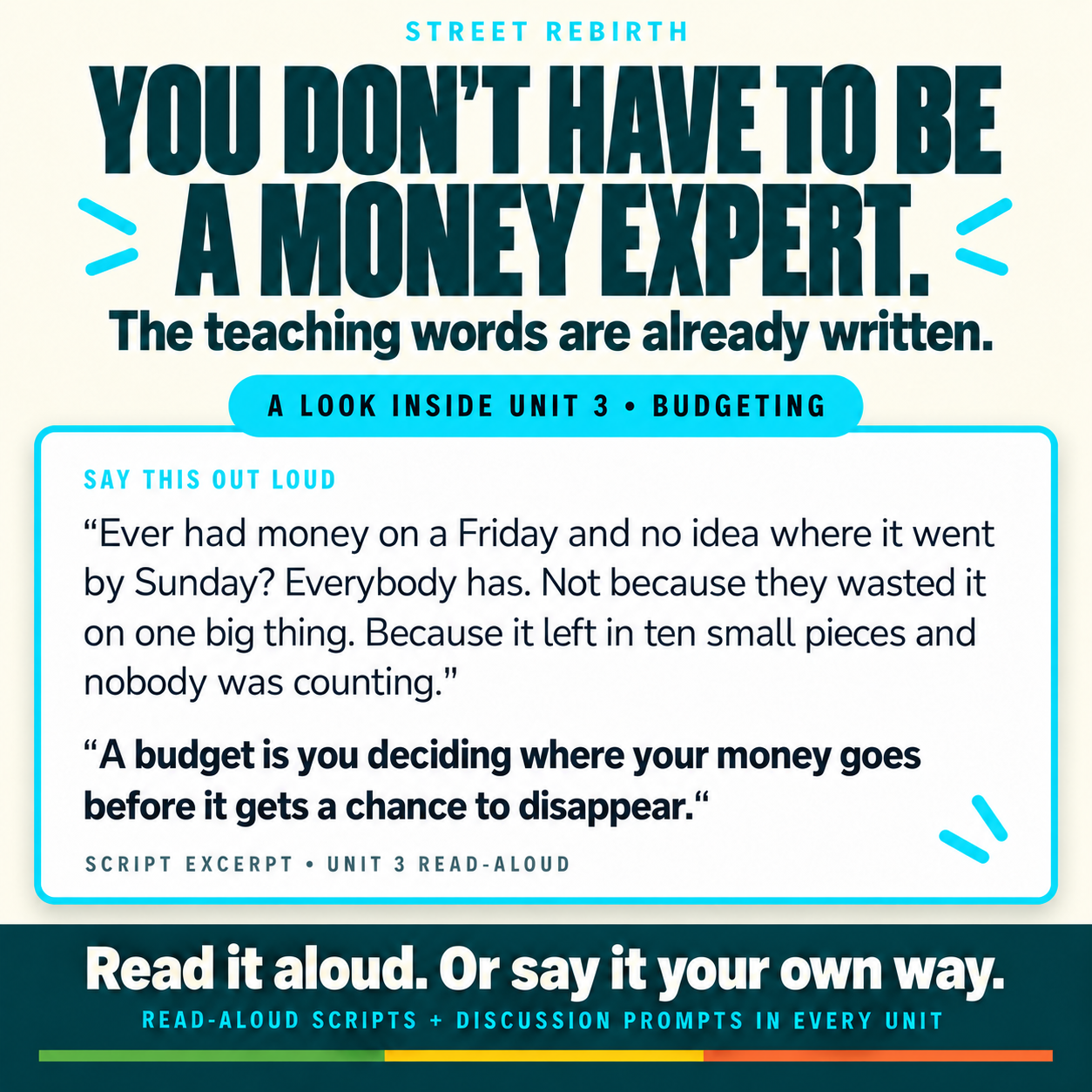
You do not need a finance background to run this. Every word you say out loud is already written for you inside the read-aloud scripts. Open the PDF, read the blue box, play the game. Prep time is about three minutes per unit and the supplies are things already in your house: a pencil, a calculator, and a handful of coins, beans or buttons.
Kids do not struggle with money because nobody defined compound interest for them. They struggle because nobody ever showed them what it feels like to pay a minimum payment for two years, or to watch one bad roll wipe out everything they put in one place. So every unit is built around a hands-on game where round one usually fails on purpose.
In The Minimum Payment Trap they grind out a credit card balance by hand and discover that only fifteen dollars of a twenty-five dollar payment touched what they owed. In The Penny or the Prize they turn down a million dollars and watch a single penny become over five million. In Run the Booth they price a product, calculate break-even, and then a competitor sets up next door. In You Are the Bank they lend out everybody's deposits and cause a bank run themselves. That is the moment the lesson sticks, and it lands in fifteen minutes with no real money on the line.
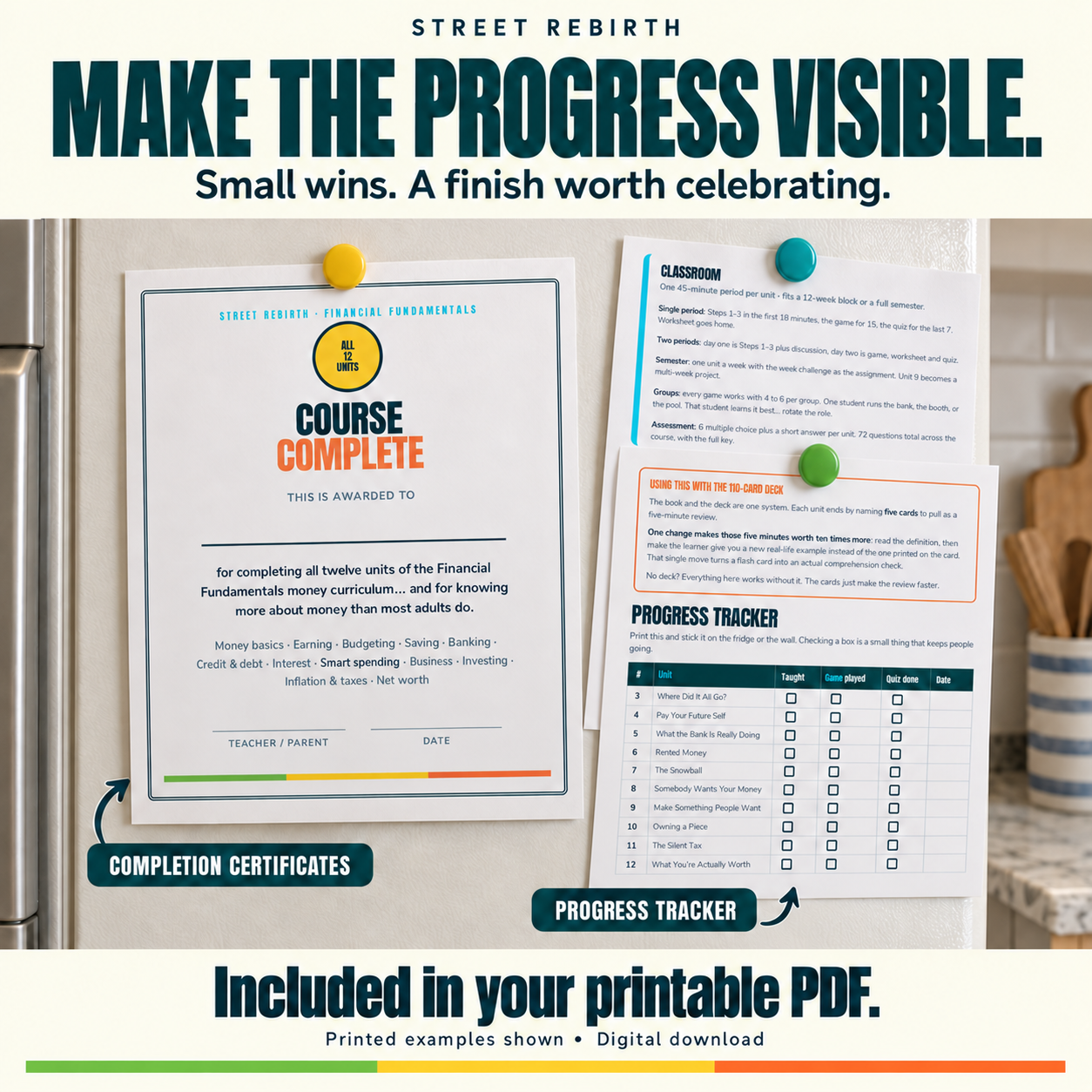
Three pacing guides are included, because a classroom and a kitchen table are not the same room. Teachers get a single 45-minute period per unit that fits a twelve week block or a full semester, with group sizes, assessment structure and a parent letter template. Homeschool families get a three-day rhythm per unit. Parents get the simplest version of all: twenty minutes at the table on a weeknight, the game on the weekend, twelve weeks and done.
Every unit also includes age adaptations for 8-10, 11-13 and 14-15 built directly into the lesson, so one purchase covers a nine year old and a fourteen year old at the same table.
Each unit runs fourteen pages and follows the same five-step system: Learn It, See It, Remember It, Try It, Level Up. Inside every single one you get a read-aloud teacher script with wrong-answer coaching in the margins, a real-life application section, a Myth Buster that corrects what most people get wrong, a memorable fun fact, a hands-on game with setup and rounds, a four-question debrief, a printable student worksheet, a full worksheet key, five multiple-choice questions plus a short answer, a quiz key with a 3-point rubric, cut-in-half exit tickets, three age adaptations, five flash card pairings, a dinner table question and a week challenge to send home.
The Month is a capstone simulation that plays four weeks of working adult life in about ninety minutes and uses all twelve units at once... a job, a paycheck, bills, and one event card a week nobody saw coming. There is also a 20-question pre-course check to run before Unit 1, a matching post-course check and a growth report that puts the two scores side by side, so you can actually prove it worked.
Plus printable play money, game cards, a mock pay stub and bank and card statements, six reusable templates (budget, savings goal, net worth, break-even and a business one-pager), a complete 79-term glossary, a printable progress tracker for the fridge, three certificates including a family pledge, and a parent letter template teachers can copy and send home before day one.
Teacher pages are full color and only you ever look at them. Student pages are deliberately ink-light: black text on white, thin rules, no filled backgrounds, every worksheet on exactly one page. A full twelve-week course runs about 36 sheets per learner, and ten of the twelve unit games need nothing but paper, a pencil and household objects.
This curriculum runs on the same three learning levels and the same teaching system as the Street Rebirth 110-card Financial Fundamentals deck. Each unit ends by naming five specific cards to pull as a five-minute review. You do not need the deck for any of this to work, but if you own it, the book and the cards become one system instead of two separate purchases.
Homeschool parents building a personal finance block. Teachers handed a financial literacy requirement with no materials. Youth program leaders, mentors, tutors, scout leaders, church and community groups. And parents who just want their kid to see a paycheck, a credit card offer or a four-easy-payments button and not be seeing it for the first time.
Nothing ships. This is a digital file. The download link appears immediately after checkout and is also emailed to you, so you can grab it on a phone, tablet or computer. Because it is a file and not a package, there is no shipping cost, no address needed and no delivery window.
Print the whole book, or print only the pages you need. Worksheets, the tracker and the certificates are designed to print clean on standard 8.5 x 11 paper from any home printer. Certificates look best on heavier cardstock. The book reads perfectly on a tablet or laptop if you would rather not print at all. For personal, family, homeschool and single-classroom use.
Educational material only. It teaches how money works and does not provide personal financial, legal, tax, credit or investment advice. Dollar figures and percentages in the games are round numbers chosen to make the math teachable, not predictions or recommendations. Money-earning activities should be done with parent or guardian guidance and follow local rules.
Create. Inspire. Empower.